

 Re-mark
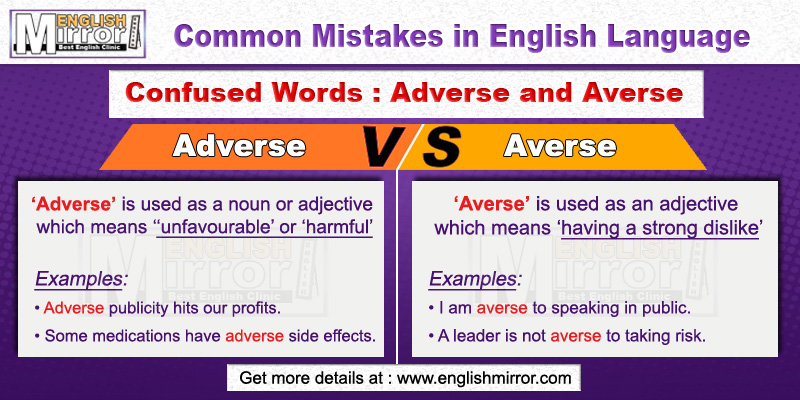
Adverse and Averse confused and misused words - English Mirror Distinguished Adverse and Averse which are often confused by English speakers. Avoid common mistakes using words with same pronunciation like adverse and averse in English. Adverse Averse ------------------ ‘Adverse’ and ‘averse’ are not only spelled similarly (with the ‘d’ in ‘adverse’ being the only difference), they are also both adjectives with negative connotations, and hence easily confused. ‘Adverse’ means ‘unfavourable’, or ‘harmful’. Therefore, if a sportsman is said to perform well in adverse conditions, it means that he or she performs well in conditions that are not easy to play in. It is used in reference to things, actions or events, rather than people. Adverse publicity hits their profits. ‘Averse’ describes a strong disinclination. It is used of things and people, but we never speak of an averse thing or person. It is most often used in the form averse to, as in I am averse to speaking in public. He was not averse however to taking chances for himself.
You may like

Hire freelance scientists and research scientists for hire from a global pool of 20,000+ experts. Post your job free…
Hire freelance research scientists, freelance research scientists

The Ultimate 2026 Training Management Software Checklist: Cut Through the Hype
This buyer's guide explains how to…