

 Re-mark
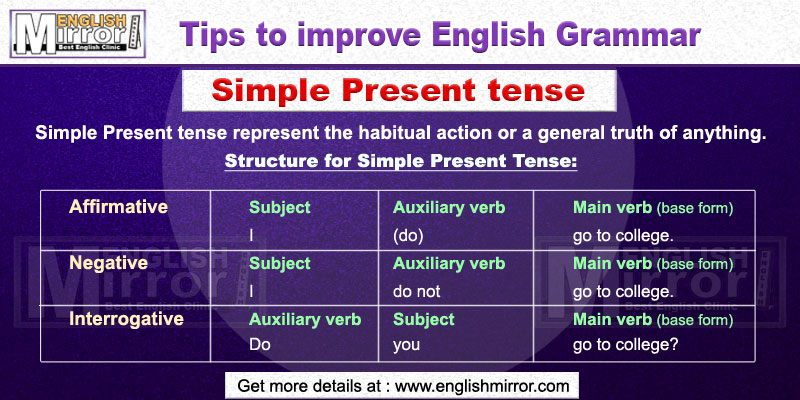
Simple Present Tense in English Simple Present tense is used when, the action is simply mentioned and there is nothing being said about its completeness. Get uses and examples of simple present tense. What is Simple Present tense? "Simple Present tense represent the habitual action or a general truth of anything." In the English language, Simple Present tense is used when, the action is simply mentioned and there is nothing being said about its completeness. It is used to talk about an action which happens on a regular basis. Basic Structure of Simple Present tense: • Structure for Simple Present • Subject Auxiliary verb Main verb subject (do) base form I (do) go to college. • Structure for Negative sentence • Subject Auxiliary verb Main verb subject do + not base form I do not go to college. • Structure for interrogative sentence • Auxiliary verb Subject Main verb Do subject base form Do you go to college? We normally use the simple present tense when: • the action is general, • the statement is always true, • the action is not only happening now, • the action happens all the time, or habitually, in the past, present and future. There are three important exceptions: • For positive sentences, we do not normally use the auxiliary. • For the verb to be, we do not use an auxiliary, even for questions and negatives. • For the 3rd person singular (he/she/it), we add 's' to the main verb or 'es' to the auxiliary.
You may like

RajaRajeswari College of Engineering in Bangalore Karnataka

Accreditation Standards
education
7 Reasons to Choose Arizona State University for Study Abroad in 2026 - Hellouni Blogs
Arizona State University, Arizona State University ranking, student life at Arizona State University