

 Re-mark
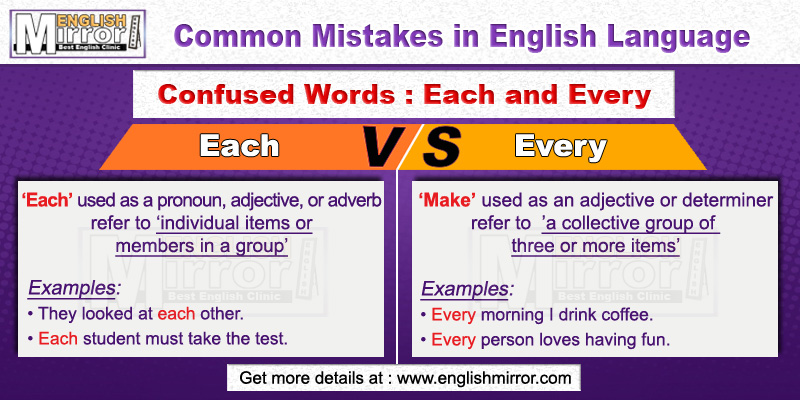
Each and Every confused and misused words - English Mirror Distinguished Each and Every which are often confused by English speakers. Avoid common mistakes using words with same pronunciation like each and every in English. Each Every ------------ The words, ‘Each’ and ‘every’ are ‘used with singular nouns to indicate quantity’. There are differences between the two that are important to grasp for usage, though. ‘Each’ is used when there are two objects, here ‘every’ is not used. ‘Every’ is used to refer to repeated, regular events. For example, He wore multiple bracelets on each hand (note: singular noun). There were two of them. They each carried backpacks, and each backpack (note: singular noun) contained invaluable souvenirs. In case there are more than two objects, either of the two may be used. He wanted each/every item on the catalogue. There is a bathroom in each/every room. ‘Each’ can be used as a pronoun, but ‘every’ cannot. Note the difference between the following sentences: The students were waiting for the question sheets to be handed out. Each was in a state of great nervousness. The students were waiting for the question sheets to be handed out. Every student/one of them was in a state of great nervousness. Clearly, ‘each’ replaces the noun ‘student’. ‘Every’ does not; it requires to be followed by the noun, or by ‘one of them’. With adverbs (practically, nearly, almost, etc), only ‘every’ in used. In the following sentences, ‘every’ cannot be replaced by ‘each’: She knew practically every detail of his daily routine. Nearly every fruit on the cart was spoil. ‘Every’ is used to refer to repeated, regular events, as in the following cases: We meet every so often I get a health check-up done every six months. I had to take a water break after every other set. In the above examples and any similar instances, ‘each’ cannot be used.
You may like


Is Hybrid Learning the Future of Education? Where Does Instructor-Led Training Fit in 2026?
Organizations today are…

Struggling with health issues? If you need time off work, understanding the process is key. At Get Healthcare UK, we…