

 Re-mark
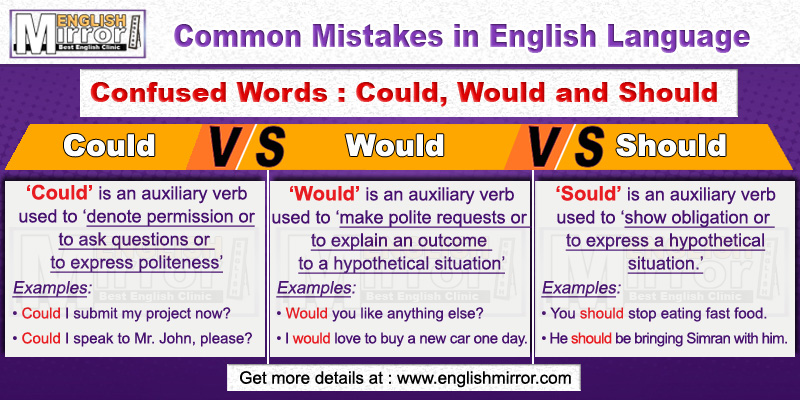
Could, Would and Should confused and misused words - English Mirror Distinguished Could, Would and Should which are often confused by English speakers. Avoid common mistakes using words with same pronunciation like could, would and should in English. Could Would Should ------------------------ The words ‘Would’, ‘should’ and ‘could’ are auxiliary verbs, meaning that their function is to assist main verbs. They can be defined as the past tenses respectively of will, shall and can, but each has many uses that sometimes even express the present tense. It is important to be able to differentiate between the three so as not to use them incorrectly. The words ‘Would’, ‘should’ and ‘could’ are auxiliary verbs, meaning that their function is to assist main verbs. For example, in the sentence, ‘I would like to meet him’, ‘like’ is the main verb that is assisted by ‘would’. They can be defined as the past tenses respectively of will, shall and can, but each has many uses that sometimes even express the present tense. It is important to be able to differentiate between the three so as not to use them incorrectly. We shall discuss some of the common functions of the three words here. used to denote permission or to ask questions or to express tentativeness or politeness. Could 1. As the past tense of can: There was a time when I could run a mile without breaking a sweat. 2. To ask questions: Could I submit my assignment now? = Am I allowed to submit my assignment now? 3. To show possibility: You could do a lot better. = You have the potential to do a lot better. 4. To express tentativeness or politeness: I could be wrong. = I may be wrong. used to make polite requests or to explain an outcome to a hypothetical situation. Would 1. To ask questions: Would you like to see the doctor? = Do you want to see the doctor? 2. With ‘who’, ‘what’, ‘when’, ‘where’, ‘why’, ‘how’: How would he react? What would she do? In both sentences, ‘would’ is more or less interchangeable with ‘will’. 3. To make polite requests: I would like more salad, please. = I want more salad, please. 4. To show a different response if the past had been different: I would have done something if I had known you were in trouble. = I didn't know that you were in. This is why I did not do anything to help. 5. To explain an outcome to a hypothetical situation: Were I to win a million dollars, I would go on a world cruise. = If I win a million dollars, I will go on a world cruise. 6. To show habitual past action: The dog would howl whenever its owner would leave it alone at home. Think of ‘would’ as ‘did’. 7. To show preference between two choices, used with rather or sooner: I would sooner face the punishment than lie and escape it. = I prefer speaking the truth to lying. 8. To show intention: He said he would do it. = He said it was his intention to do it. used to show obligation or to express a hypothetical situation. Should 1. To ask questions (it is generally interchangeable with ‘ought’ in such cases): Should I submit my assignment now? = Am I supposed to submit my assignment now? 2. To show obligation: You should brush your teeth twice a day. Here, too, ‘should’ can be replaced with ‘ought to’, but in this context it is used to make a persuasive statement. 3. To express a hypothetical situation: Should you wish to do so, you may. = If you wish to do so, you may. 4. To express what is likely: If you take the highway, you should be there in two hours. Here, ‘should’ means something like ‘probably will’.
You may like


Is Hybrid Learning the Future of Education? Where Does Instructor-Led Training Fit in 2026?
Organizations today are…

Struggling with health issues? If you need time off work, understanding the process is key. At Get Healthcare UK, we…